

Are You Desire Smuggling?
"Giving”, “Giving”, “Giving”, in an attempt to earn love.

Desire smuggling: Hiding what you really want from yourself and/or a loved one, then finding covert strategies to get (at least pieces of) what you want.
“I’m here if you want to talk about it.”
“How can I help?”
“Need a check in?”
“I’m here.”
What a good friend I am, I thought. Showing up, offering my support without pressure while my friend is experiencing heartbreak; gently letting them know I’d be here, whenever they were ready to talk about it.
So why was I was I feeling increasingly frustrated, rejected, and disconnected when my friend didn’t take me up on my offer?
I found myself getting pushy about it: Now do you want to talk? How about now?
Turns out, I was desire smuggling.
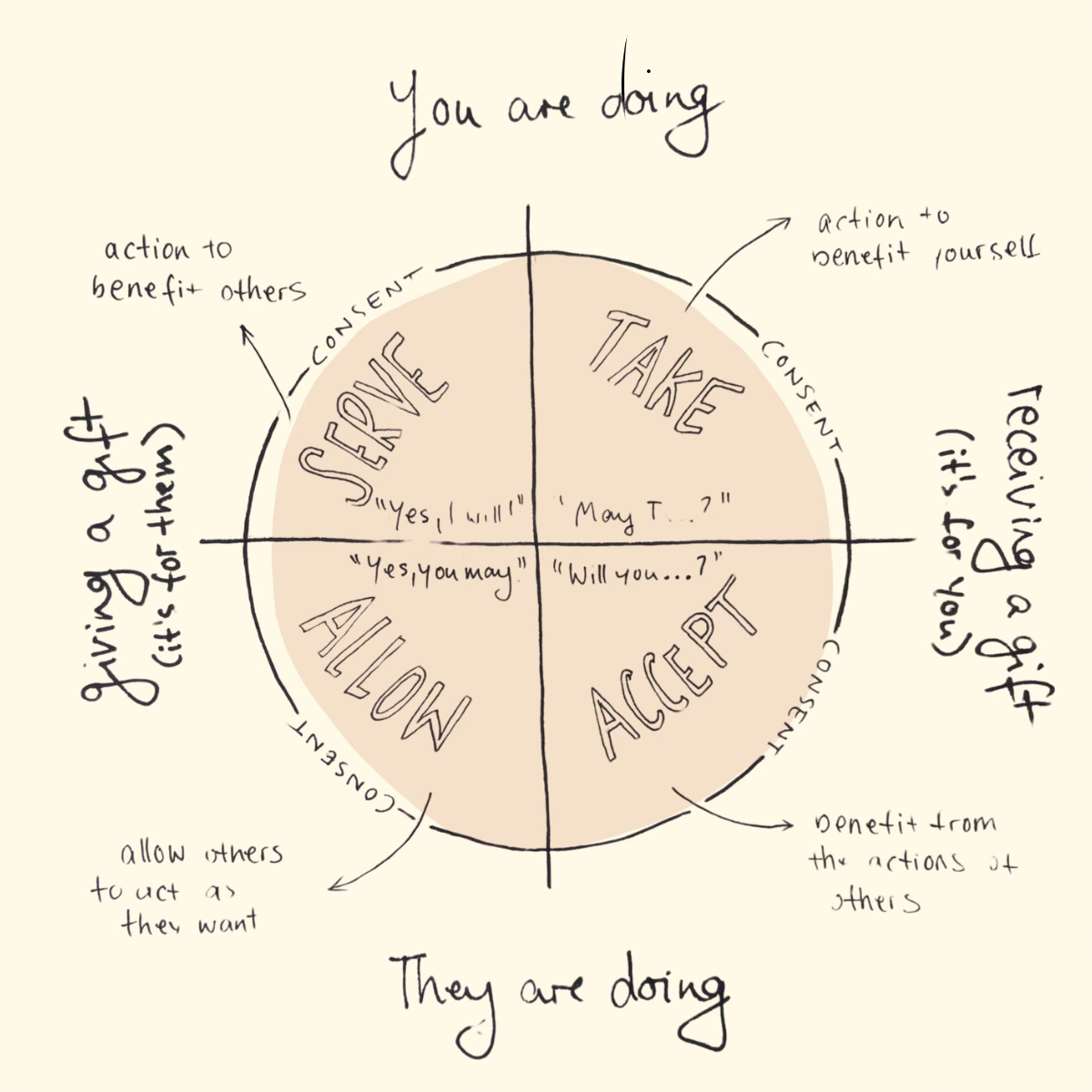
I understood what was happening when I came across the phrase ‘desire smuggling’ in The Art of Receiving and Giving (The Wheel of Consent) by Dr. Betty Martin.
[Read my introduction to the framework here]
Desire smuggling: Hiding what you really want from yourself and/or a loved one, then finding covert strategies to get (at least pieces of) what you want.
Yes, I wanted to be helpful and to be a good friend. But there was something else I wanted even more: I wanted connection, I wanted to be allowed in. I wanted access to my friend’s thoughts and emotions. I wanted to know what was really going on for them.
I wanted to feel connected. I wanted in.
And here I was, attempting to smuggle in my desire for connection by casually making myself available: “I’m here if you want to talk about it.”
Why Desire Smuggle?
Why do we desire smuggle? Why hide what we really want from ourselves and/or loved ones and then find covert strategies to get (at least pieces of) what we want?
Why not just say what we want?
Well, let’s see:
Women are socialized to believe their desires don’t matter. Men are socialized to believe needing things makes them weak. Neurodivergent people learn their real needs aren’t real. Everyone is told they’re too sensitive, that asking is a burden, that desires only count if you can justify them logically. The highest praise is not needing things at all.
[See also: Needs? Who, me? I don’t have any needs. ]
With that in mind, it makes sense that for many of us, hanging out in the giving half of the Wheel of Consent feels more comfortable1.
We try to desire smuggle because receiving is vulnerable!
Dr. Betty Martin says in her book:
“Receiving is inherently vulnerable. Our desire, pleasure, tenderness, gratitude, and shame are exposed. You risk being denied or ridiculed by others, feeling shame, embarrassment, or disappointment. You risk getting what you want and experiencing pleasure and gratitude.”
As a result, when receiving feels hard for us, she says, we may “try to use giving as a way to get things like appreciation, acceptance, self-worth, recognition, access, or sex.”
The thing is, this is not giving at all—it’s manipulating. It’s using your “receiver” to make yourself feel better.
One of the most powerful lines in the book is this:
“The determination to stay out of either Receiving Quadrant and keep your partner there means putting them in the more vulnerable place so that you can avoid it.”
Yeah, let that sink in. If you’re trying to hang out in “giving” so that you don’t have to ask for what you desire, you’re keeping your friends in the vulnerable receiving side.
Does that dynamic sound familiar? Have you ever tried to use giving as a way to get appreciation, acceptance, or self worth? If so, there’s no shame. You’re only human, after all.
And: there’s another way to be. You can learn to receive. Let’s explore that next.
Asking for what we want is easy and natural.
“Receiving brings us face to face with the fact that we need each other. As difficult as that can be to acknowledge, it is also what heals us.”
Wait, asking for what we want is easy and natural? I have to admit, I’m not fully believing this yet. I keep reading over the line in the book, and I’m not there — not yet, but Dr. Martin makes a good point:
“Asking for what we want is easy and natural; it’s the only thing we know how to do at birth. It’s hard because along the way we had bad experiences with it, so we stopped. We had to make up some convoluted way to get what we needed: hint, manipulate, steal, or pretend to offer. When you recover asking, it’s a huge relief for you and everyone around you.”
I’m finding this bit really touching, and it gives me hope:
Receiving is great for cracking our hearts open.
“Receiving cracks open the heart, which is to say it engages the emotional system in ways that evoke compassion for yourself and others and contributes to your awareness of your vulnerability. This heals self-doubt, connects us to each other, opens new perspectives, and nourishes the hungry soul. It teaches us that we need each other. This may be the hardest part. It’s not great for keeping us insulated from our vulnerability, but it is great for cracking our hearts open.”
Back to my friend and my own attempt at desire smuggling
“The determination to stay out of either Receiving Quadrant and keep your partner there means putting them in the more vulnerable place so that you can avoid it.”
Once I realized that I was avoiding being vulnerable by offering my support instead of asking for what I wanted, I decided to make a bid for connection.
I went from “I’m here if you want to talk about it” to this:
“Do we want to find a way to hang out? Online I mean. It would be nice to grab a drink or whatever and hang out. Could be talking about all of this; could be talking about anything but this. Idk. I understand if you don’t want to at the moment but I’d like to.”
I’d like to. That was the key phrase. Talking was on my want-to list.
In hindsight, I could have been even more direct, but it was a start.
The response? “I’d like that.”
Oh, what relief. Because let me tell you, this wasn’t just about rephrasing it. I had to admit, I was bracing myself for rejection — even though I wanted to be so chill about it.
But that’s what it means to be vulnerable, I guess; heart cracked open.

Thank you for following along!
🫰🏻Hanna
Monthly Gathering (free): I’m opening this one up to all subscribers. Join me for an open conversation (with anchors) about the Wheel of Consent.
Paid Subscriber Bonus Post: now published: a bonus post with 7 practical steps you can take now to stop desire smuggling.
Coaching: If you’re experiencing dynamics like desire smuggling in your friendships, coaching can be a great space to explore what’s going on and to identify steps to change the pattern. Learn more on my website. We always start with a no-pressure call to connect. I look forward to hearing from you.
If you don’t feel loved, you can try to earn love by “giving.” Receiving teaches you that you are already loved.
Just because giving can feel more comfortable or where we feel we “should” be, the giving half isn’t without challenge. Dr. Betty Martin shares that allowing and serving (the two different quadrants in the giving half) have different challenges, but what they have in common is how hard it can be to respect our own limits!
My daughter told me – don’t deprive others the pleasure of giving to you.
I guess love is the oil that smooths the path of life.
Really appreciated this post, and I bumped this book you mentioned up in my TBR queue bc I really need to read it!