


Can we all agree that nobody actually enjoys difficult conversations?
They’re vulnerable and risky. We might be put in a position where we have to face some uncomfortable truths; where we might have to be open to the idea that we might not have been honest with ourselves; where we might feel feelings in the presence of another person.
Intimacy (yuck!).
And also, these are just the conversations that can bring us closer.
To the truth, to ourselves, to each other.
Today, I want to share another Bird Constellations conversation with you. You can watch the recording or read through six quotes below.
Together, Sarah Teresa Cook and I explored:
what it means to be interactive in a relationship
what actually makes a conversation vulnerable
what might make someone unwilling to be changed by another person
why people might avoid uncomfortable truths
the idea that a conversation only becomes labeled “difficult” after something has gone unsaid for too long
that some things (including relationships) are not permanent
Before we dive into the content, I want to share two meta level thoughts. Feel free to skip ahead.
As I re-watched our conversation so I could take notes to highlight key points, I was fascinated: Observing myself speak, I could so clearly see two separate processes happening in my mind. On the surface, I am speaking in abstract, generalized terms; below the surface: very real and present emotions and thoughts processing in real time.
There’s only one spot where I slipped and let the lines blur. Did you catch it?
I wonder how many of you experience thinking in this way — consciously holding multiple separate, different layers of the experience, sharing only parts, while simultaneously being fully aware of the full, complex, emotional experience.
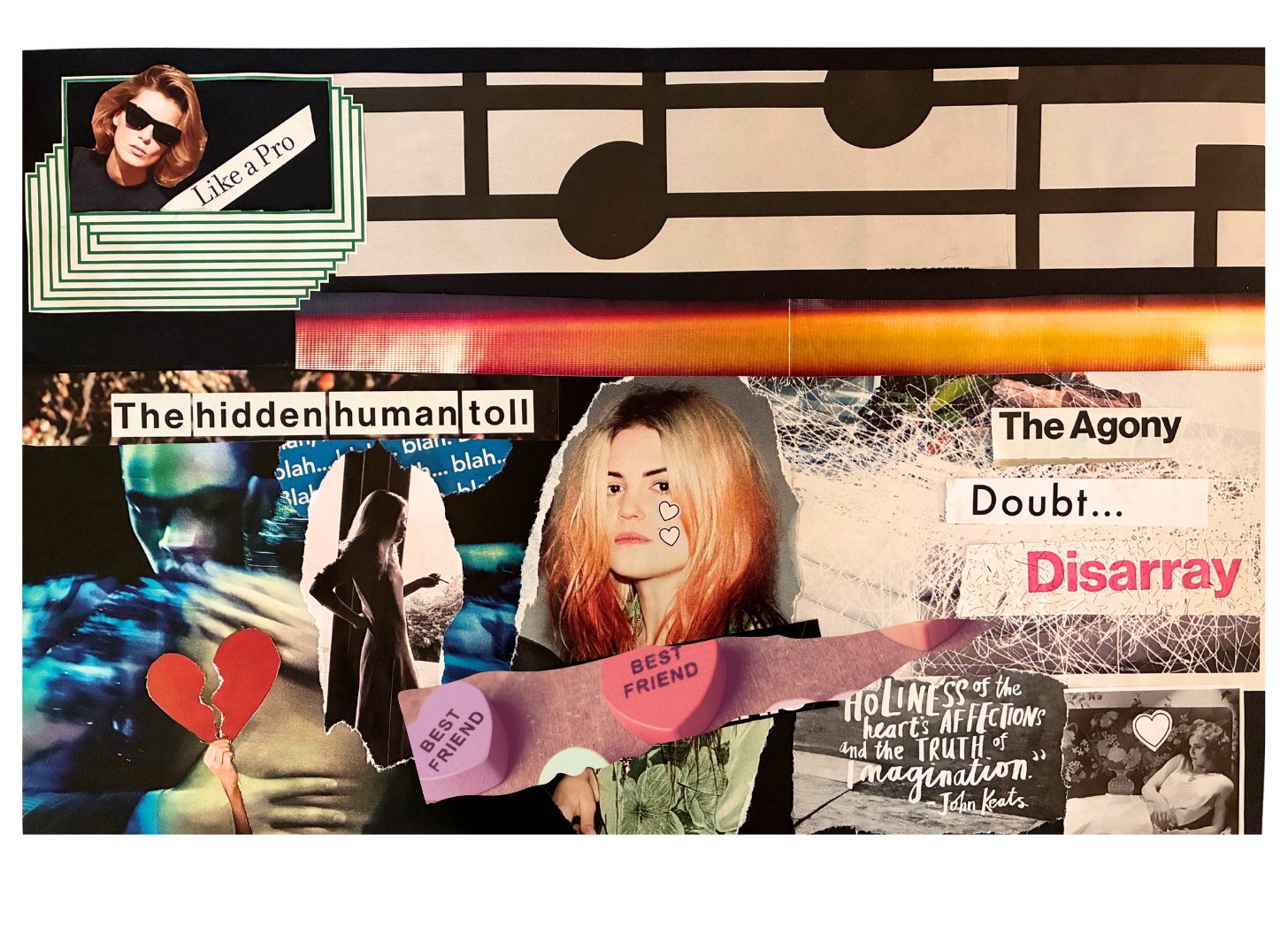
The collage accompanying this piece is meant to reflect this.
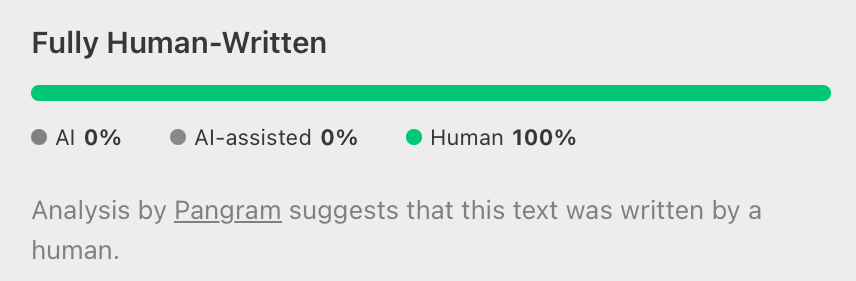
How I made this: Because I got distracted, I did not take notes. Instead, I used AI to pull quotes + introduction lines from the transcript. Substack can’t do an AI check on videos yet, so out of curiosity, I put just the text into a new post to find out what it might say. Fully human, AI, or AI-assisted? Well, the results may or may not surprise you. For context, see last week’s post.
now… onto the conversation about difficult (or vulnerable + risky) conversations:
Entry Point: “…it asks you to be interactive.”
Sarah and I entered the conversation with a quote from the book Conflict Is Not Abuse by Sarah Schulman:
“This is not a book to be agreed with, an exhibition of evidence or display of proof. It is instead designed for engaged and dynamic interactive collective thinking where some ideas will resonate, others will be rejected, and still others will provoke the readers to produce new knowledge themselves. Like authentic, conscious relationships, truly progressive communities, responsible citizenship, and real friendship, and like the peace-making that all require, it asks you to be interactive.”
“act on each other, act reciprocally,” 1805, from inter- + act (v.).
interactive(adj.)
“acting upon or influencing each other,” 1832, from interact (v.)
Interaction is messy.
We talked about what it means to be interactive in a relationship, and Sarah used the habit of running someone’s writing through an AI detector as an example of the opposite.
Sarah: Okay, for example — and I don’t want to make this a conversation about AI, I don’t want us to be mistaken as the AI ladies — but it is not interactive to me to walk around on Substack making assumptions about what people are writing and click a button and have a machine tell me whether something is human or not. That’s not interaction, that’s assumption. It’s policing, surveillance, all those things we talked about. It’s keeping the person at a distance versus asking a writer about their process. If you get the sense someone’s using AI, have a conversation with them about it. That’s interactive — going toward the person rather than farther away. It’s messy. Interaction is messy. Intimacy is messy. It is yucky sometimes because you’re all up in each other’s humanity, and we’re not perfect, clean, ideal people. We’re people.
vulnerability = being open to receive something from another person and potentially be changed by it.
We talked about what actually makes a conversation vulnerable, and I pointed out that it might not be the part everyone assumes.
Hanna: We said earlier about how vulnerable that can be, but this is also it. It’s not just sharing bits of yourself — stating an opinion, or sharing a bit of feeling, or showing an unknown where maybe you don’t have the answers yet — and making yourself vulnerable in that way. But in order for it to be interactive, and really collaborative and reciprocal, you also have to be open to receive something from the other person and potentially be changed by it. That’s a whole other level of vulnerability.
Why might people avoid vulnerable + risky (aka difficult) conversations?
We talked about what makes someone unwilling to be changed by another person, and Sarah started by naming her own opposite tendency.
Sarah: It feels risky. It feels scary. Because I was going to say — oh, I don’t want to be changed, but I actually kind of do want to be changed. I’m not... I am a person who, if anything, I have to be a little careful in the opposite direction. I am aware that I am so porous and so impressionable that I can lose myself more easily, you know, and that’s — I hear trauma, I hear neurodivergence, I hear all the things — but so what makes someone feel like, oh no, I don’t want to change? Is it disposition? Is it a hard thing if you’ve never experienced this kind of uncomfortable but beautiful intimacy and these kinds of conversations — is it an easy thing to be really scared of if you haven’t experienced it? Are some people just closed-minded? What is it?
“I can’t have this conversation” might just mean “I’m not ready (yet) to hear it.”
We talked about why people might avoid uncomfortable truths even when the signs are obvious, and I shared her my experience recognizing burnout too late.
Hanna: I think maybe one of my examples is when I was in burnout, when I was still working at Amazon — the signs were so clear. My manager once suggested a book to read titled Burnout, and I was like, ‘I’m not in burnout’. In hindsight, of course I was. But it was scary for me to even consider it, because I was afraid of the implications. If somebody had sat me down and said, “you cannot do this anymore, you need to take a step away from all of this,” it just felt like my whole life was going to collapse if I acknowledged that one thing. I didn’t see myself here, doing things like this. There was no space for it. So it felt safer to just keep the status quo instead of letting one idea poke through and have one hard conversation about it. My walls were so solid, so tall, because I felt like everything else would have crumbled.
“Difficult conversations” don’t just come out of nowhere.
We talked about the idea that a conversation only becomes labeled “difficult” after something has gone unsaid for too long.
Hanna: I’m wondering if by the time we get to the point where we say we need to have a difficult conversation, if that is a sign that we haven’t had enough vulnerable or risky conversations all along. If things aren’t being said for a long time because we’re afraid of what that might change, or how that might change the relationship, because it makes us vulnerable and we might feel rejected — that we then don’t say those things. And what if we then come to a point where that thing that’s been floating along unnamed bumps up against something real and shows up in some unexpected way. And now all of a sudden it forces two people to have a heart-to-heart and a difficult conversation.
Things (including relationships) are not permanent. And that’s hard.
We talked about whether every hard conversation is even worth having, and Sarah shared a 12-year friendship that ended, restarted, and ended again — and that sometimes, a relationship has run its course. I wasn’t ready to accept that.
Sarah: I had a really intense friend breakup maybe two years ago. Really messy, really messy — it would take a long time for me to tell you the whole story — with someone who I’d been friends with for at least 12 years. And it was amazing that the friendship ended and then started again and then ended again, in any way. I do feel now, looking back, what was revealed was that the relationship had kind of run its course. And I have a little bit of a feeling in my body as I say that, of like, well no, but then that means somebody didn’t try hard enough or something. I don’t think the point of everything we’re talking about is that if everybody does everything right, we’re all going to be friends and all relationships will last forever. I think people come and go and things end, and that’s scary and sad too — that things are not permanent. That’s hard.
Now, over to you, friends:
→ What makes difficult conversations so difficult?
→ What, in your experience, can make it easier to have risky + vulnerable conversations?
→ Is there a risky + vulnerable conversation you know you need to have? How can you support yourself?
→ What are your reflections on the idea that vulnerability isn’t only about opening up to share thoughts and feelings, but also to be potentially influenced, changed?
Join the conversation in the comments or reply to this email.


